
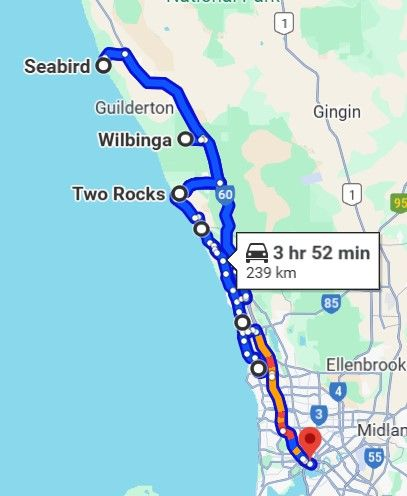
Destination: Two Rocks, WA
Distances:
• Perth → Two Rocks: 75 km
• Two Rocks → Seabird: 100 km
• Total distance: 244 km
Terrain:
This tour follows sandy tracks that wind through the landscape, at times soft, loose, and steep.
While there are no extreme sections, the beaches can be deceptively soft — real sand traps for the unwary. Anyone approaching the beach should always check on foot first to ensure the route is driveable.
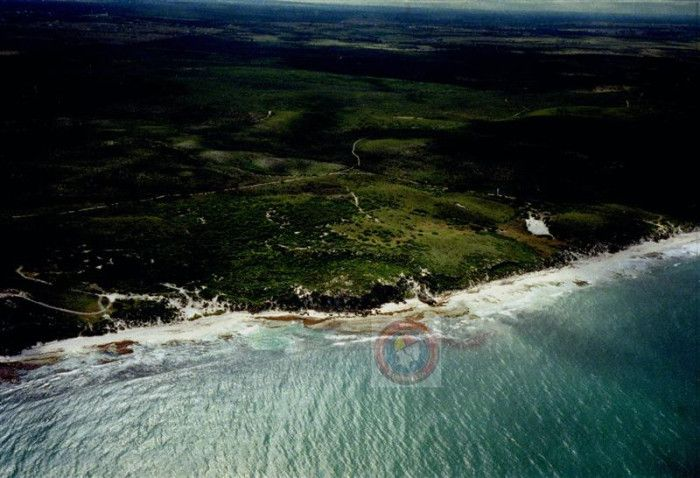
The Gingin Ranger asks all four-wheel-drive drivers to avoid a small hill near Cape Leschenault — about 2 km south of Seabird. The vegetation there is heavily impacted and needs time to regenerate. Along the entire route, the usual rules for responsible driving apply:
- Reduce tyre pressure on sandy terrain
- Observe warning and information signs
- Follow existing tracks only
- Mount a clearly visible flag on a tall pole – for better visibility in dunes and depressions
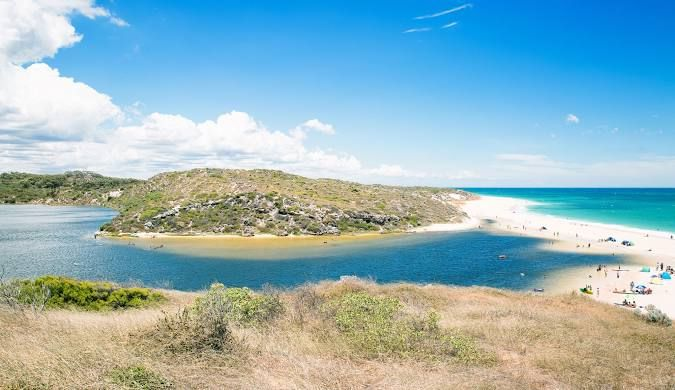
The Moore River winds picturesquely between coastline and riverbed. It rises near Walebing and flows for around 200 km before reaching the ocean. Historically, it is closely linked to the early explorations of Western Australia:
• In 1830, Captain Thomas Bannister reported the river mouth
• In 1836, George Fletcher Moore followed the river inland — he named it the “Garban River”, after the name used by the Aboriginal people
• In 1839, Surveyor General John Septimus Roe established the connection between Moore’s inland explorations and the coastal mouth while searching for survivors of George Grey’s failed expedition.
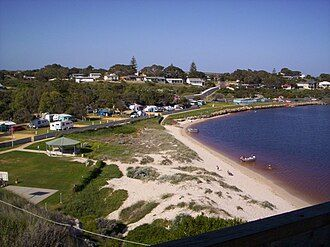
The river mouth was known to Aboriginal people and early settlers as “Gabbadan” and became a popular resting place for pastoralists from the 1880s onwards.
In 1893, the de Burgh family built a hut there. Soon after, a campsite was established with three holiday cottages and a well, managed by the Gingin Roads Board.
In 1910, a road was constructed, making the area accessible to motorists. In 1920, residents of Gingin called for land to be made available at the site.
During the Second World War, the army used the holiday cottages. After the war, settlement was again advocated, and in 1951 Guilderton was officially recognised. The name was coined by historian Henrietta Drake-Brockman and commemorates the shipwreck of the *Vergulde Draeck* in 1656.
Seabird was named after the schooner “Seabird”, which ran aground near Cape Leschenault in 1874. The cargo — mainly Oregon timber, along with dry goods and beer — was auctioned in Gingin. Much of the timber was salvaged directly from the beach and still features in some houses in the region today.
In the 1950s, H.W. McCormick established a fish-smoking operation near the wreck site — using a lifeboat from the “J.P. Webb”, which was wrecked on the reef in 1551.
More settlers followed, and by the mid-1960s Seabird was officially recognised as a town. The proposed name “Chalon” was rejected — locals pushed for “Seabird” and were right to do so.